ORLANDO | “Are there any Filipinos here?”
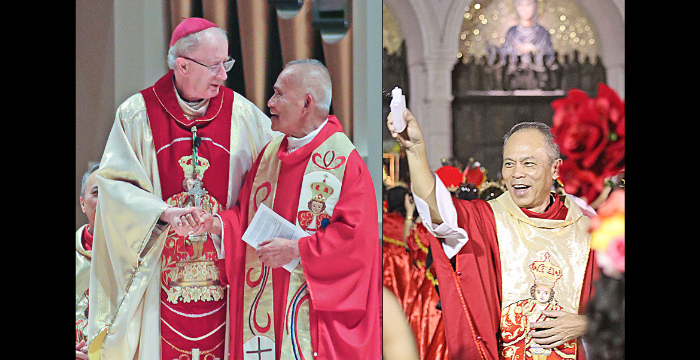
It was a question Bishop John Noonan said in jest as he stood upon the altar of the Basilica of the National Shrine of Mary, Queen of the Universe in Orlando Jan. 25, 2026. And the query was met with laughter from 1,700 Filipinos gathered in the pews, many of whom wore traditional Filipino attire — barong tagalog, a traditional embroidered formal shirt for men, and the Baro’t Saya for women, which is a traditional blouse and skirt.
The gathering marked the 20th annual celebration of the feast day of Santo Niño, known as protector of Cebu and the Philippines. And the feast started with a bang. Literally. Specifically from snare drums, which were played at the entrance of the Basilica Shrine.
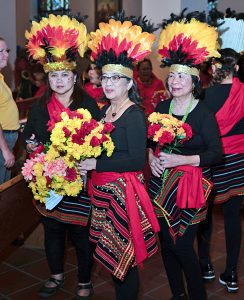
The crisp beats reverberated against the walls and got the whole congregation moving — those in the pews and those awaiting to process. Members of the Filipino community from across Central Florida, Tallahassee and Tampa held banners and statues of Santo Niño. Some women wore elaborate gowns, others wore feathery headdresses, and every one of them swayed to the beat and held up their statues down the aisle as congregants clapped and held up their own statues.
The view was a kaleidoscope, and the joyous nature contagious. The sights and sounds offered a glimpse of the love Filipinos hold for their heritage and their faith.
The last to process were men carrying a statue of Santo Niño in an enclosed case. At the side of the first pews were members of the Knights of Columbus offering a salute as the statue approached. And behind the statue were the bishop, the rector of the Basilica Shrine and seven Filipino priests who serve in the diocese. They each wore vestments bearing an image of Santo Niño.
“Father Ivan (Olmo, rector) and I are the only non-Filipino priests up here. Wow,” Bishop Noonan joked, before adding seriously, “What a blessing to have so many Filipino priests for our community. Like all of you and like Santo Niño, they are here on a journey of faith.”
The bishop gave special recognition to Father Bernard Fernando, the oldest of the Filipino priests. At 92, he will mark 62 years as a priest in May. “Father Bernard, and all these priests, got to know Christ in their homeland and are here to share Christ. What a blessing.”
Bishop Noonan extended that thanks to the community at large. He said many of those present are immigrants themselves who have made roots in the United States, and for that, he is grateful.
“Each of you took the journey to the United States, settled here, raised your families here and gave this country your gifts of faith and service,” he said. “We thank you for what you have brought to us here, what you put in your heart, your very soul.”
“And your roots call you back to the Santo Niño, to the child Jesus, who is calling you to know Christ in our life,” he continued. “All these reflections of who you are, is a reflection of the gift of the Child Jesus.”
Mila Ecle of Orlando was one of the organizers for the event. A native of the Philippines, she grew up with a Buddhist grandmother and a Catholic mother, so she remembered going to the temple and the Catholic parish as she grew up.
It wasn’t until she came to the United States and became active in the Filipino community here that found her faith flourish. The feast day for Santo Niño along with other large gatherings, such as Simbang Gabi during Advent and the feast of Our Lady of Peace and Good Voyage (Our Lady of Antipolo) in July ignite a love for her faith and her heritage even more.
The feast of Santo Niño, which culminated a nine-day novena held at various parishes in the diocese, honors the birth of Catholicism in the Philippines more than 500 years ago. Historical accounts say Spanish explorer Ferdinand Magellan landed on the shores of Cebú in 1521, and gifted a statue of the Child Jesus to the king and queen when they and other natives converted to the faith.
“I am so glad I came to the U.S. because that is when I became infused in a prayer group and (it) slowly formed me to become a volunteer of this. God opened my eyes to the traditions,” Ecle said, who attends Mass at Good Shepherd in Orlando and Sts. Peter and Paul in Winter Park. “The highest Catholic population in Asia is in the Philippines. And during the Santo Niño celebration we especially pray for the children. The kids growing up in the U.S. can become so Americanized. We have to show them how important it is to have their faith and have a connection to the holy infant Jesus.”
There are still things Ecle is learning about traditions. As the choir and congregants sang some native hymns, people could be seen lifting up handkerchiefs and waving them. Even some of the priests on the altar waved their hands as they sang the lyrics. Ecle asked a fellow Filipino member from Cebu what that meant and was told it is a way to demonstrate you are surrendering yourself to God.
“It is as if you are waving to the Lord saying, ‘Here I am, Lord. I am surrendering myself to you,’” she explained.
During a celebration in Cebu Jan. 18, 2026, that gathered 5.2 million people, a letter was read from Pope Leo XIV. He said the annual feast, guided by the theme “In Santo Niño We Are One,” would inspire the faithful to live out their baptismal commitment through a grace-filled life in Christ, marked by service, charity, and solidarity, particularly toward those on the margins of society.
“It is, therefore, his hope that you will be inspired by a greater desire to embrace the baptismal call to live a grace-filled life in Christ and in service to your brothers and sisters, especially those on the margins of society, so that you will bear greater witness to Christ’s call to unity and reflect the life of charity of the Most Holy Trinity,” the pope said.
The Mass ended with Father Kenny Aquino, pastor of St. Vincent de Paul Parish in Wildwood and director of the Filipino ministry, leading the congregation in shouting, “Pit Senyor!” The phrase means the community entrusts God with their concerns.
As the priests, bishop and the encased statue recessed out of the Basilica Shrine, the community continued worship outside with Sinulog, cultural prayer-dances especially choreographed to honor the Child Jesus. The dances depict historical accounts of the Spaniards’ arrival and subsequent conversions. The word Sinulog describes the forward and backward movements to the sound of drums.
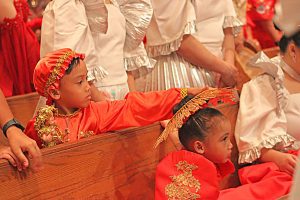
At that time, children with flowers were blessed, along with Santo Niño statues held by community members.
By Jean Gonzalez of the Florida Catholic staff, January 30, 2026