VIERA | With two young boys with autism, Mass for Candace Melo and her husband, John, felt challenging rather than a source of peace or an opportunity to spiritually refuel.
Their eldest fidgeted, the youngest, often loud, needed to move about. Eventually, they spent a year away from the Church, feeling there was no place for them. Then St. John the Evangelist Parish began a sensory friendly Mass and the dynamic changed.
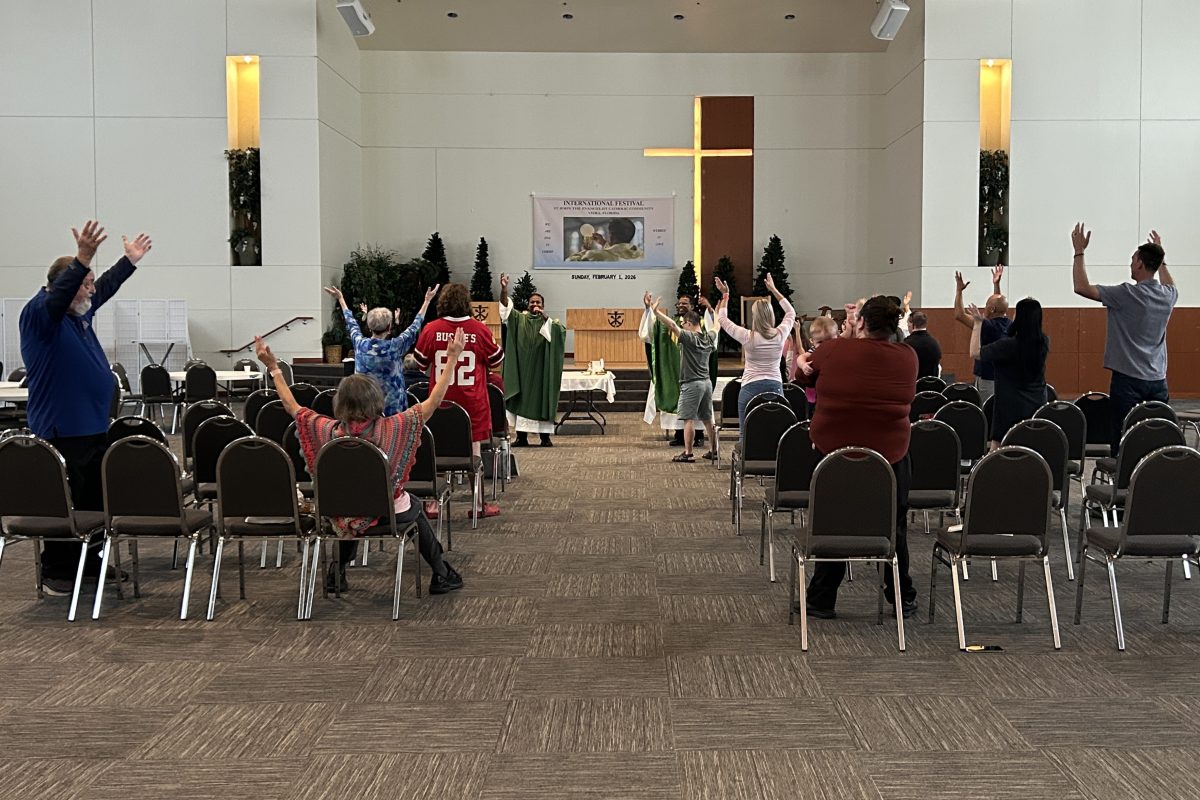
The monthly Mass has dim lights, softer music, no incense and a sensory station for those requiring hands on activity all in a large hall with plenty of personal space. Above all, it is a welcoming environment for those with intellectual or developmental disabilities, the elderly, people with dementia or Alzheimer’s disease, or anyone battling sensory issues.
Melo never heard of this type of celebration but always dreamed of something like it.
“I was just thinking of it and praying about it so hard. And then I got an e-mail asking if I’m interested,” she said. “(Before) we could never go to Mass as a family. I had to keep my youngest son home. He is extremely high support needs. He would never be able to attend a typical Mass.” She explained, “It would be, not only disruptive for everyone else, but it would be pretty traumatizing for us because we’d have to force him to be quiet and sit down.”
“We were really drowning,” she recalled. “We were struggling. So, we weren’t practicing the faith as much and we struggled.”
Three years ago, they decided they wanted their eldest to receive faith formation and the Sacraments. Determined to make it work, they took turns going with their eldest while one remained at home with the youngest, sometimes missing Mass altogether.
“It’s like you’re winging it day-to-day, right? And you’re not as grounded. You don’t have that relationship anymore with God and with your spouse.” She recalled it feeling awkward not to experience or practice their faith as a family. “I would say we were a little lost and it was harder to live day-to-day with the autism. The autism was the thing keeping us away, but it was also the reason we really needed it in our lives.”
When the parish announced a new Sensory Friendly Mass, she was all in. Her mother and sister-in-law went with them. Holding back tears, she no longer felt isolated. There were people with headphones, children moving in the back of the room, others engaged in the sensory station. When her son made loud noises, no one turned to look. She found gratitude, a sense of belonging and no stigma.
At the sensory friendly Mass, there are no expectations,” she explained. “I don’t have to put energy into changing (my youngest’s) behavior. I’m able to focus on faith… It doesn’t take away the day-to-day struggles, but I’m reminded that I don’t have to carry the weight myself. I have community around me. I feel like I am protected. I feel like I do belong.””The sensory friendly Mass was the idea of parishioner Denise Yelvington. Yelvington has two teenagers on the spectrum and stress from crowds, echo, and music eventually led her son to leave the Church. He would clutch his ears, scream, cry and need to leave. Soon she noticed her daughter would not sit in Mass either. She wanted to be in the Narthex with noise-cancelling headphones. Feeling she was on the verge of having another child “give up on the Church”, she reached out to a Catholic Facebook group and asked if anyone knew about a sensory friendly Mass. Multiple women shared links to parishes and the Archdiocese of Philadelphia’s Office of Persons with Disabilities. Yet another site linked her to a resource guide for bringing such a Mass to her parish.
She approached pastor, Holy Cross Father John Britto Antony, and sent out a survey asking who might be interested. Impressed by the response, Father Antony offered a Mass in the parish hall to see how it would go. The carpet offered a sound safe environment, and the open space made it possible for participants to spread out. The dim lighting was calming.
Yelvington was not surprised. About 50 people participated in that first Mass last year and since then they’ve had up to 75 participate. “It’s something that I think is affecting a pretty large population and if I feel like, if the churches don’t adapt, we’re going to lose people because we will lose whole families,” said Yelvington.
Soon Jamie Waller joined her in the new ministry. Waller has six children and two are neurodivergent. Her 15-year-old son also battles anxiety and struggles in public places, so church can be challenging. Sundays became a battle of wills. Once they arrived at Mass, he would take off and wander campus. She followed, often livestreaming Mass from her phone while walking around the parish’s beautiful grotto.
She would tell her son, “I feel like, as a mother, my job is to get you to heaven, and I have to at least bring you to church.” Although she missed the first sensory friendly Mass, she called Yelvington. They met with Father Antony and set up a schedule to offer it monthly. Now her son offers no resistance. He enjoys Mass and is even talking about receiving the Sacraments. When Father Antony or Salesian Father Martin Joseph, sing and encourage hand motions, she sees her “big, tall kid get right in there.” She said, “It just warms my heart because he feels just so comfortable in that space.”
“It hardly occurs to most of us that the regular parish Sunday Masses can be exhausting both for our autistic children and their parents too,” said Father Antony. “In establishing this ministry at St. John’s, we are responding directly to the Gospel call to care for the vulnerable, ensuring individuals with autism and other special needs can fully participate in the Eucharistic celebration without undue sensory overload. Features like no music, dimmed lights, no incense, flexible seating, visual aids, and a dedicated sensory-stimulation area create an environment where all can encounter Christ more freely. Father Martin and I find great joy in ensuring that those with special needs know that we care for them and we love them.”
By Glenda Meekins of the Florida Catholic staff, February 19, 2026