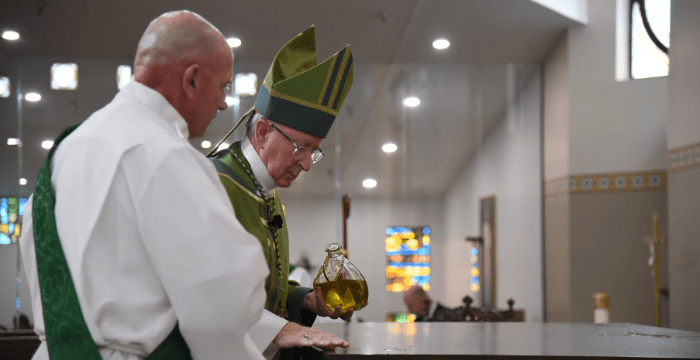
ORLANDO | On March 30, Bishop John Noonan will bless the sacred Chrism, Oil of Catechumens, and Oil of the Sick at the annual Chrism Mass. The oils will be used throughout the year when celebrating the Sacraments of Baptism, Confirmation, Anointing of the Sick and Holy Orders (for bishops and priests).
The following article outlines a brief historical and theological framework to better understand the use of sacred oils in the Roman Rite.
Use of oil in Sacred Scripture
The Old Testament is replete with examples of oil being used to consecrate objects, places and people. Jacob sets up a sacred pillar and pours oil over it (Gen 28:18), Moses anoints Aaron with oil to consecrate him as high priest (Ex 29:7, Lv 8:12, Ps 133:2, Sir 45:15), Moses consecrates the tabernacle and altar with oil and sprinkles it upon Aaron, his sons, and their vestments (Lv 8:10-11, 30), Samuel pours oil on Saul’s head to anoint him King of Israel (1 Sm 10:1), the spirit of the LORD rushes upon David after Samuel anoints him with oil (1 Sm 16:13), Zadok anoints Solomon as King David’s successor (1 Kgs 1:39), Elisha’s aide anoints Jehu king over Israel (2 Kgs 9:1-6), and oil is designated for anointing throughout the Psalms. (Ps 23:5, 45:8, 89:21)
While the word oil appears more than 200 times throughout Scripture, the New Testament employs two key uses of oil in sacramental life. First, in the Gospel of Mark, when Jesus sends the Twelve Apostles out two by two, they “drove out many demons, and they anointed with oil many who were sick and cured them.” (Mk 6:13) In his epistle, St. James implores that the sick “should summon the presbyters of the church, and they should pray over him and anoint [him] with oil in the name of the Lord.” (Jas 5:14) This instruction provides the Scriptural basis for the Sacrament of Anointing of the Sick.
Use of sacred oils in the early Church
Around 180 A.D., St. Theophilus of Antioch chastises a nonbeliever writing “are you unwilling to be anointed with the oil of God? Wherefore we are called Christians on this account, because we are anointed with the oil of God.” (To Autolycus, Book I, Ch. 12) Although he may be referring to a spiritual, rather than physical anointing, the latter practice is evident at the beginning of the third century A.D. Tertullian explains around 203 A.D., that after a person is baptized, they are “thoroughly anointed with a blessed unction”, through which a physical action affects us spiritually. (On Baptism, 7) St. Hippolytus, writing in 215 A.D., mentions two different types of oil present at Baptism: the oil of exorcism, anointed before immersion, and the oil of thanksgiving, anointed after immersion. (Apostolic Tradition, 21) The indispensable nature of the post-baptismal anointing was also defended by St. Cyprian of Carthage in 255 A.D. “It is also necessary that he should be anointed who is baptized; so that, having received the chrism, that is, the anointing, he may be anointed of God, and have in him the grace of Christ.” (Epistle 69, 2)
What are the oils made of?
In Exodus, the Lord tells Moses to mix multiple spices (myrrh, cinnamon, cane, and cassia) with olive oil to create a sacred anointing oil used to consecrate all aspects of the tent of meeting and Aaron and his sons as priests. (Ex 30:22-30), “It may not be used in any ordinary anointing of the body, nor may you make any other oil of a like mixture. It is sacred, and shall be treated as sacred by you.” (Ex 30:32).
Today, the 1983 Code of Canon Law requires holy oils used to administer the Sacraments must be “pressed from olives or other plants.” (CIC, c. 847, §1) The oils must be consecrated or blessed recently by a bishop unless it is necessary to use older oils. (CIC, c. 847, §1) However, in a case of necessity, a priest may bless the oil to be used in the Anointing of the Sick during the celebration of the Sacrament. (CIC, c. 999, n. 2)
Renae Bennett, Archivist for the Diocese of Orlando, shares how the holy oils were prepared for this year’s Chrism Mass. “The Sacred Chrism is prepared by mixing Laudate Chrism Essence, a special fragrant blend of aromatic oils including balsam, into a portion of the olive oil. The oils are poured into more than 330 glass jars. One jar of each of the three oils is placed in a small box for every parish, special ministry, such as prison ministry, and for Bishop Noonan. They are then labeled and sorted to be picked up after the Chrism Mass and taken to their locations.”
Why anoint with oil?
Anointing with oil signifies the Holy Spirit, “to the point of becoming a synonym for the Holy Spirit.” (CCC 695) Anointing with oil has numerous meanings in Sacramental life. (See CCC 1293) “The pre-baptismal anointing with the oil of catechumens signifies cleansing and strengthening; the anointing of the sick expresses healing and comfort. The post-baptismal anointing with sacred chrism in Confirmation and Ordination is the sign of consecration.” (CCC 1294)
Use of sacred oils in the Sacraments
In the early Church, the anointing with Chrism during Baptism was celebrated alongside the anointing of Confirmation. (CCC 1290) However, a custom developed in the Latin Church of a later anointing with sacred Chrism which led to the current practice of Confirmation. (CCC 1291)
“Very early, the better to signify the gift of the Holy Spirit, an anointing with perfumed oil (chrism) was added to the laying on of hands.” (CCC 1289) St. Thomas Aquinas writes it is fitting for the confirmandi to be signed with chrism so that, marked with the sign of Christ, “neither fear nor shame may hinder (them) from confessing the name of Christ.” (Summa Theologiae III, q. 72, a. 9)
Church Fathers such as Origen, St. John Chrysostom, and St. Caesarius of Arles appealed to the instruction from James 5:13-15 in their exhortations regarding the Anointing of the Sick. In 416 A.D., St. Pope Innocent I defended its sacramental character, writing there “is no doubt that this anointing ought to be interpreted or understood of the sick faithful, who can be anointed with the holy oil of chrism… it is a kind of sacrament.” (To Decentius, 25,8,11). Still today, the priest lays their hands on the sick, prays over them in the faith of the Church, and anoints them with blessed oil. (CCC 1519)
Bishop John Noonan recalls every newly ordained priest kneels before the bishop, who anoints “their hands with chrism. The day I was made a bishop… the bishop poured chrism on my head.” While the anointing on the palms configures the priest to serve in the person of Christ, the anointing on the head signifies that episcopal consecration confers the fullness of the Sacrament of Holy Orders upon the bishop. (CCC 1557, 1563)
What’s the difference between the sacred Chrism, Oil of Catechumens, and Oil of the Sick?
Holy Chrism “will be used to anoint infants after Baptism, those who are to be confirmed, bishops and priests at their ordination, and altars and churches at the time of their dedication.” (USCCB, Order for the Reception of the Holy Oils) The Oil of Catechumens is used “for the anointing of those preparing for Baptism” while the Oil of the Sick is used during the Anointing of the Sick. (USCCB, Order for the Reception of the Holy Oils)
By Lucas Blackwell of the Florida Catholic staff, March 26, 2026