ORLANDO | When Father Fred Ruse read a pastoral letter offered by Florida’s episcopal shepherds July 27, 2026, the timing could not have been more appropriate.
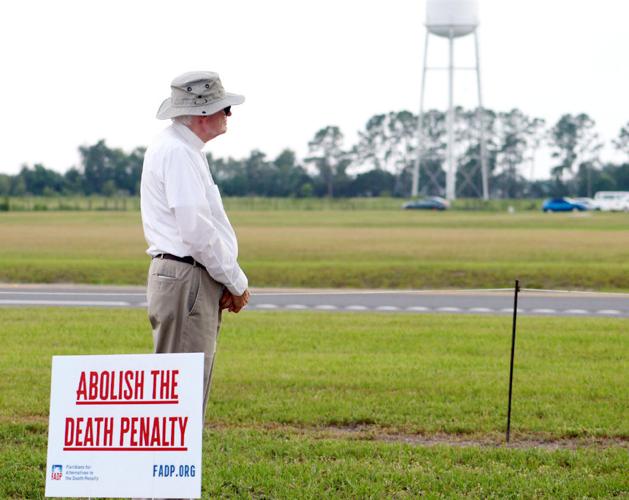
The day after the Florida Conference of Catholic Bishops released “A Pastoral Letter on the Death Penalty,” Father Ruse stood in a familiar field under the hot noon sun. Across from the field stands Florida State Prison, and specifically the death house where one man awaited death a mere hour from the time Father Ruse first arrived. Five hours later, the clock would tick the last hour for another inmate.
Florida executed 19 death row inmates in 2025, and on July 27, James Duckett and Dominick Occhicone became the 11th and 12th inmates, respectively, executed in 2026.
“I think that the timing is significant because it starts out by saying this is a response,” Father Ruse said. “(There is a) timeliness to it and (an) extreme relevance to it, obviously because of what is happening right now. … It’s our teaching as a church, and we have some ground here that’s been established for a while and been building up.”
The pastoral letter reaffirms Church teaching that capital punishment is unnecessary and incompatible with a culture of life. It explains that, given today’s secure methods of incarceration, capital punishment is no longer justified.
“In this letter, we wish to remind Catholics of the teaching of our Church against the use of the death penalty in situations — like our own — where bloodless means are sufficient to punish offenders and protect public safety,” the bishops write in the nine-page letter.
Father Ruse has been an outspoken opponent of the death penalty for almost 30 years. In 2002, he served as spiritual advisor to Ricky Sanchez-Velasco and spent five hours with him before his execution. Father Ruse was in the witness room as authorities delivered the lethal injection.
These days Father Ruse is a fixture at the vigils before executions, many times alongside Father Phil Egitto, pastor of Our Lady of Lourdes Parish in Daytona Beach. Father Ruse traveled with a contingent from the parish to Florida State Prison in Starke to protest the double executions. The letter offers scriptural basis as explanations for the rejection of violence as punishment, and Father Ruse said it is significant the bishops immediately point to Jesus’ own words and deeds as the basis for rejecting capital punishment.
“In the Sermon on the Mount, Jesus rejected the use of or appeal to violence and taught His disciples to do the same, insisting instead on the need to offer sinners, whatever their sins might have been, opportunities for redemption and reconciliation,” Father Ruse said of the account outline in page two the letter. “This is not new to the Church. This is not new to the way we look at our discipleship. … This (is) the continuity of the words of Jesus to the very present moment.”
The letter offers examples such as Jesus’ teaching about retaliation (Mt 5:38-39), Jesus’ response to a Samaritan village’s inhospitality (Lk 9:52-55), the woman caught in adultery (Jn 8:3-11), and the parables of the unforgiving servant (Mt 18:21-35) and weeds (Mt 13:24-30) as lessons against capital punishment. Father Ruse explained these parables focus on healing, not violence.
A section of the letter focuses on Evangelium Vitae. Released in 1995, Pope St. John Paul II’s encyclical on the Gospel of Life marked a new development in the Church’s teaching on capital punishment. The bishops’ letter reproduces the first two paragraphs of Evangelium Vitae 56 in full, where St. Pope John Paul II discusses the death penalty. The relevant passage states authorities should “not go to the extreme of executing the offender except in cases of absolute necessity: in other words, when it would not be possible otherwise to defend society. Today however, as a result of steady improvements in the organization of the penal system, such cases are very rare, if not practically non-existent.”
“I think the bishops make (the) point here in the United States, more than anywhere, we are so much further advanced in terms of incarcerating the wrongdoer,” Father Ruse said, adding life without the possibility of parole is a different matter of “dealing with wrongdoers for the well-being of society.”
Father Martin Nguyen serves as pastor of Holy Family Parish in Orlando and is a canon lawyer. He said Evangelium Vitae is a “reiteration of the Church’s teaching from the beginning” — that value of human person and dignity has always been upheld because each person is created in imago Dei (image of God).
“What may set it apart is the application of this teaching on the value of human life and dignity to the modern society,” Father Nguyen said. “Capital punishment violates human dignity in two ways. It takes into human hands the power to terminate a human life which the Church has always upheld as sacred and God, the sole author, has the right to give and take. And it entirely eliminates the possibility of redemption and conversion which human beings are all capable of.”
The bishops’ letter emphasizes the change to the Catechism of the Catholic Church promogulated by Pope Francis that capital punishment is “inadmissible because it is an attack on the inviolability and dignity of the person.”
“Our point of reference (for human dignity) is not what they do with their life, but what Jesus has done with and for us,” Father Ruse said. “Everything created by God shares in a divine worth and value and beauty that is… in a sense, beyond the reach of our behaviors or our thinking, our decisions or our rejections or our wrongdoing.”
Another section of the letter — “A Development in Church Teaching” — highlights the understanding of slavery and developments in medicine, astronomy and biology, as examples where the Church’s understanding on certain topics have deepened over time. After quoting a section from Dei Verbum 8, the bishops’ write “(t)his describes well the process of how we have come to recognize, especially with the teaching of Pope St. John Paul II, the inadmissibility of capital punishment in our time, despite its sanctioning in the Bible and past Church practice and teaching.”
The implication of this clear doctrinal development is not lost on Father Ruse. “People are going to hold a mirror up to the Catholic Church and say, ‘You told us it’s okay at one time.’” Father Ruse added Catholics are coming out of a “long period of history” when the Church regarded the death penalty as just in limited circumstances.
Father Nguyen said it is not just everyday Catholics who held on to the belief that capital punishment was just. He used the example of St. Thomas Aquinas who believed capital punishment should only be employed as the last resort to protect the common good.
“That is to say it should only be used when there is no other way to protect the community from an aggressor,” Father Nguyen said. “This no longer holds true because of the advances in the penal and penitentiary systems where criminals could be kept securely from the community for life if necessary.”
As a pastor, he is sure some who might read the letter might counter the explanation with the “old maxim of an eye for an eye, and a tooth for a tooth.” But that expression should not be a “justification for revenge.” In “legal philosophy” the phrase “emphasizes the exact nature of a punishment.” And while it might seem that executing a murderer is a just punishment, it doesn’t bring back the life lost, and it goes against the edict that human life is priceless.
“No one should be punished more than he or she deserves,” Father Nguyen said. “At the end of the day, as people of faith, we must remember that the justice that God exacts on us on the day of our judgment should be far more fearsome than any sorts of punishments human beings can come up with. Divine justice is eternal, so are the punishments for evil deeds.”
Father Ruse said abolishing the death penalty does not create a conflict between mercy and justice. Mercy is a justice that is borne out of the Scriptures and uplifts the dignity of the human person.
“Mercy is a practice of what I think is the most elementary of justice. … We don’t throw anybody away,” Father Ruse explained. He borrowed the biblical passage of Genesis that is highlighted in the letter. “What did God say to Cain? ‘Your life is not to be taken.’ … God did not throw Cain away. He drew him closer… that was the first revelation of justice.”
The final two sections before the letter’s conclusion focus on previous responses from Florida bishops and the U.S. Conference of Catholic Bishops about the death penalty and the practical considerations regarding capital punishment. In 1972, Florida’s bishops wrote a pastoral letter against the death penalty, stating, “It is certainly our hope that the time is not far distant when capital punishment will be abolished altogether.” Similar sentiments were echoed and reiterated in statements released by the U.S. Conference in the following years, all preceding the development of the Church’s teaching.
Finally, the bishops argue on a practical level, the costs of capital punishment outweigh its benefits because capital punishment does not have a deterrent effect, it is more expensive than life in prison without parole, and there are concerns about imperfections in the criminal justice system, especially exonerations of inmates. Florida leads the United States with 30 death row exonerations since 1973.
According to Father Ruse, the death penalty, by its very presence and existence, creates more violence. “The right to life is something that’s recognized as God-given,” Father Ruse said. “(Through capital punishment) we are diminishing a kind of respect for even the wrongdoer, that person’s right to life.” He agreed with the bishops who said the death penalty cultivates a culture of death.
Florida’s bishops hope their letter will shape the hearts and minds of faithful Catholics throughout the state, including that of Gov. Ron DeSantis. Before each execution, Florida’s bishops write to the governor, who is Catholic, and urge him to stay the execution to life without the possibility of parole.
Yet, since the pastoral letter’s release two men are slated for execution. William Frances Silvia Jr. is scheduled for Aug. 18, and Harold Gene Lucas is scheduled for Sept. 1, 2026.
Lucas Blackwell, Jean Gonzalez and Glenda Meekins, all in Orlando, contributed to this report.