Editor’s note: In light of the recent attention drawn to increasing IVF and fertility insurance coverage around the nation, the Florida Catholic explores the decisions of doctors to change course, Church teaching on the matter, and moral issues at stake in a series of articles. This is the first.
ORLANDO | For years, reproductive endocrinologist Dr. Joseph Davis believed he was helping families achieve their dreams. As a fertility specialist, he spent his days guiding couples through infertility treatments, including in vitro fertilization, commonly known as IVF.
Today, he is still helping families, but his focus looks very different.
Recalling his medical education, upon graduation he felt confident. “For me, that really was the ultimate sort of focus. We’re not only helping people at this wonderful time in their lives, but we’re actually helping people to achieve pregnancy. And that’s a really, really great thing.
“I’m here to help people have families. And that always, to me, felt like a very good mission, a very positive goal, very sort of morally focused goal,” he said. Specializing in infertility he noted covering some restorative practices and taking “a deep dive into the underlying factors with fertility.” But he said once he started practicing medicine, “everything started converging or focusing on in vitro fertilization (IVF).”
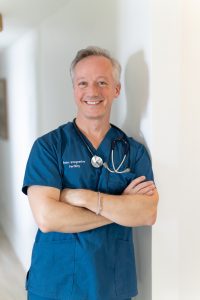
He said the choice boiled down to statistics. “The rationale of the people who go this path is, well, if our goal is to help people have a baby, what’s the most efficient, kind of best way to get people there on a truly numbers standpoint?” he explained. So, he focused on becoming the best at his job, leading to world recognized status in the field of IVF.
Looking back, he acknowledged not really paying attention to where his faith and career intersected until he and his family started getting more involved at Holy Family Parish in Orlando after living abroad for several years. He began focusing on his faith in a more “consistent fashion.” That’s when his wife mentioned, “I really think you need to look at the Church’s teachings on your career and on what you’re doing because it’s not really consistent.”
He recognized the Church had a problem with IVF but never read any of the Church documents and admits he “didn’t want to.” He eventually sat down with his pastor, Father Martin Nguyen and attended a talk on the Church’s teaching on infertility practices and why it was opposed to IVF, freezing eggs and embryos, surrogacy, and more. He also read Humane Vitae, one of the many writings regarding the Church’s teachings on procreation.
He said two messages resonated. The first was the importance of the union of husband and wife. “It was so important to look at the role that the sacrament of marriage plays within the Catholic Church and in society at large. I think that was so meaningful to me, because I guess I hadn’t really thought of that as a part of what I was doing to help people achieve pregnancy specifically. I thought it was couples and people getting pregnant, but I hadn’t thought of the marriage as a sacrament, as it connects to that.”
He said the other “aha moment” was “a combination of humility as well as conversations and prayer and discussions (about how) life begins at fertilization. And while that seems like an overly simplified thing for a Catholic to say, it’s not universally accepted or believed, not only just amongst the secular world, but amongst Christians,” he said. “There are a lot of Christians and also other faiths that don’t necessarily know when life or don’t necessarily have an agreed upon time at which life begins.”

And when he made the connection that this question of when life begins is the primary point for the abortion industry, he said, “This sort of loosey-goosey definition of when life begins for a child just didn’t make any sense. God tells us it starts right when the egg and sperm come together, like that sparked that moment that fertilization happens. Everything starts from there. It’s growing and developing. Yeah, they’re not all able to sustain themselves out in the real world until a certain stage of growth, but that doesn’t give it any less significance. So, for me, that realization life began at fertilization was a huge change because I was faced with talking to people about their frozen babies that are now created in a lab.” He remembered seeing a report noting a patient had five babies and three were “deemed incompetent because of a genetic test,” meaning they would be discarded.
“I just suddenly couldn’t unsee that,” he recalled unable to stop thinking about it. “That was the moment that really flipped the switch to say, ‘I can’t do this anymore. I can’t continue to be a part of deciding life and death for babies.’”
Then there were the words of his pastor, Father Nguyen: “You cannot do IVF and be a faithful Catholic. There are these other avenues out there for treating patients in a moral way, in a faith-filled way that you can explore.”
So began his journey into Natural Procreative Technology (Napro Tech), a women’s health science that focuses on identifying and treating the root causes of reproductive issues while working cooperatively with a woman’s menstrual and fertility cycles.
He reached out to local doctors through Facts About Fertility, a website founded by Catholic Marguerite Duane, which serves to train students and doctors in natural family planning and fertility awareness methods. He was impressed with his findings. “All of a sudden I was like, wow, I can actually do restorative gynecologic surgery and overcome a lot of these barriers that people go to IVF to bypass.” He was thrilled. “And more importantly, we can actually increase and enhance one’s own natural fertility, which ultimately is a better treatment.”
Realizing his medical practice could be better by treating the root cause in a more direct way, he said suddenly his two worlds no longer opposed one another. “I had faith that God was leading me down this path for a reason. And I just truly went to Adoration and said, ‘God, I trust that you’ve got this. I’m going to let you guide me.’”
This led him to resign and open his own practice, Palm Integrative Fertility, where he explores the underlying causes of infertility and miscarriage, does surgery if needed, and provides “a lot of integrative methods to restore and enhance natural fertility for both men and women.” The patients came and they’re still coming.
Davis finds restorative medicine offers something ART, or assisted reproductive technology doesn’t. It gets to the root cause of the problem. “And once you do find that, number one, patients are really happy to finally have an answer. But two, is that answer is now actionable and you can treat the underlying cause. And that’s so much more rewarding than telling people, ‘I have no idea what’s going on.’ Like the unexplained infertility diagnosis, which is so often given to people, it doesn’t feel good for the patient; it doesn’t feel good for the doctor to say, ‘Gosh, I have no idea what’s wrong with you.’ It feels like we haven’t really done what we came to do, which is to help people. So now, I find that there is no real unexplained infertility. There’s unexplored infertility. And when we start exploring it and we continue to look until we find the cause, now we’ve got something we can work with.”
He realizes that natural fertility is a commitment and not a quick fix. He believes this is why many people turn to IVF. It is faster. But it has its drawbacks. He recalled, “One of the outcomes (of IVF) we unfortunately saw a lot was couples separating. We would see divorces and things like that. In the natural holistic fertility world, I’m sure that may happen to someone, but it’s a lot less common because the way you go about building a family naturally encourages that couple to come together, at every aspect. Whereas part of what we believe is the reason for the divorces with the IVF rate is that by nature, it’s a system that separates couples.” He points out, with IVF, everything is done separately. This is another issue the Church sites for its disapproval. It separates the marital act which is meant to be unitive.
Today, Davis’s practice is busy. He acknowledged the difficulty in finding doctors who practice natural methods and restorative medicine, but encourages patients to go to https://www.orlandodiocese.org/ministry/natural-family-planning/ where they can find information on Natural Family Planning, Catholic doctors, and more.
Our next article will cover what the Church teaches on the subject and why.
By Glenda Meekins of the Florida Catholic staff, September 11, 2026