ORLANDO | As another school year begins, students and teachers return to classrooms throughout Central Florida. Lurking in the background is a technology that has the potential to be a disruptive and destabilizing force on the modern education system: artificial intelligence.
“Disarming” AI is at the center of Pope Leo XIV’s first encyclical, Magnifica Humanitas, on safeguarding the human person in the time of artificial intelligence. The encyclical evaluates the promises and dangers of AI, its effects on humanity, and the responsible path forward through an analysis of the five major principles of Catholic Social Teaching: the common good, universal destination of goods, subsidiarity, solidarity, and social justice. Education is the central focus of 11 paragraphs.
Pope Leo XIV writes, “School is the place where new generations can learn to seek and love the truth, to reflect on the meaning of life and to recognize the dignity of every person.” (MH, 143) “First and foremost, when we’re talking about human dignity, is making sure our kids understand the dignity of others,” said Misty Merritt, principal at Annunciation Catholic Academy in Altamonte Springs. “I really think the strength of our Catholic schools and Catholic education right now is our identity. The strength in our ability to tackle this challenge (of AI) is the strength of our identity, because we’re not trying to figure out what our value system is.”
In August 2024, the Diocese of Orlando Office of Schools updated its Student Technology Responsible Use Policy to include language surrounding AI. It states AI “can serve as a helpful tool for many processes… However, age-appropriate AI tools should not replace a student’s own work.” The policy notes students should use AI ethically and cite when it is used. While the policy allowed students to use AI with teacher approval, an update in 2025, clarified, “teachers will communicate with students when age-appropriate use of AI tools may be permissible for assignments in certain classes.”
The policy addresses another major concern, plagiarism. It states, “presenting material using AI without teacher’s approval will be considered academic dishonesty and will result in consequences.” For the first time this school year, to add moral guidance, the diocesan policy addresses a non-academic use of AI. The policy says students “must not use AI to create any AI-generated inappropriate images of classmates, teachers, coaches, or administrators.”
For Mary McCrory, associate superintendent of Catholic Schools, the original guidelines and best practices are a step in the right direction. McCrory notes the policy permits teachers to allow students to use AI but “you have to show them how to use it properly,” first teaching them “how to distinguish between what is real and what is not real, because there’s so much fake (information) out there.” She stresses everything generated by AI must be verified by cross-checking with additional sources. “I think that’s something that we have to stress,” says McCrory. “You have to verify whatever it is that AI comes up with on your own to make sure that (it is correct).” She acknowledges that “AI is fluid and evolving,” and the policy must be as well.
When it comes to integrating AI at Annunciation, “we always want to do so in a way… that we’re comfortable with and that we feel like is in line with our mission,” added Merritt. “I think our approach here toward any technology and towards AI has been an approach of intentionality.”
“We are given (diocesan) directives and there’s not wiggle room, as far as how we implement them, because they’re specific guidelines for the safety of the children. So, in that area we follow exactly what we’re given,” shared Lisa Jones, technology specialist at Annunciation. “But we all have a little bit different learning environments and tools, so how those guidelines translate into our specific environments… we have to adjust to make those work, (and) we all have different tools to make that happen.”
At Annunciation, AI lessons are built into the eighth-grade curriculum. “Most of our students are not 13. If they’re 13, it’s usually later in eighth grade, so they cannot use AI tools directly,” said Jones. Most major large language models, like Open AI’s ChatGPT and Meta AI, require users to be 13 years old to use their platforms. However, many educational platforms are adding AI features to their suite of products.

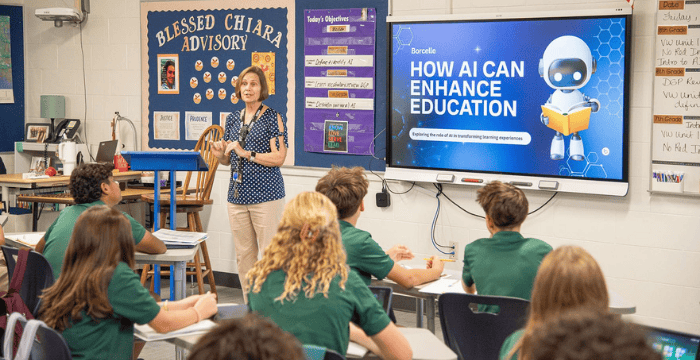
Inside a classroom full of eighth-grade students, Stacie Humphreys, middle school language arts teacher, began her lesson on how AI can enhance education with a question: “What are your thoughts about AI… who has used it?” Almost every hand quickly shot up in the room.
“Let me tell you about the pitfall of using (Google AI) without going to the source,” continued Humphreys. She explained during research project on Eucharistic miracles, a student asked Google AI if a particular miracle had been studied, and whether there was any medical documentation. Google AI replied “no.” “I said, let’s go take a look at this website,” shared Humphreys. “So, we pushed on the website and guess what? Lo and behold, it was a different miracle altogether.”
For Humphreys, taking time to carefully explore the benefits and corresponding dangers of AI is key to teaching students how to use it responsibly. “We’ve got to start understanding how to… discern what is good, how we’re going to investigate, and honestly, how we’re going to use AI ethically and morally to align with our Catholic values because we don’t want to cheat, right? We want to be able to use it as a tool,” said Humphreys. “It’s a great tool, but we have to kind of know how to use it. So, we’re going to start in school with our training wheels.”
Educators acknowledge not all AI tools should be treated the same. “As we assess these tools… we know our value system,” reflected Merritt. “Now we have to navigate these tools in light of it.” Jones continues to reevaluate tools when companies add AI features. Some AI educational tools are “great and some can be used by students without repercussion, but others we need to look at turning off,” she noted. “So, it’s just constantly staying abreast of what’s being introduced and integrated into tools you already know well.”
Pope Leo XIV writes “every technology shapes those who use it. Educating people about the use of AI, then, involves teaching them to decide when and for what purpose it ought not to be used.” (MH, 140) For Merritt and Jones, the biggest challenge is teaching students why restrictions exist and instilling the virtues needed for responsible use. Merritt wants students to understand the reasoning behind guardrails curtailing AI usage and how AI shortcuts can be detrimental to their own work. “Helping them understand why that’s a bad thing… and kind of what they’re losing, in the process (of utilizing AI),” explained Merritt.
To guide Catholics in their discernment, Pope Leo XIV recalls the inviolable dignity of each person. “In the era of artificial intelligence, when human dignity is threatened by new forms of dehumanization… (we have) the pressing duty to remain profoundly human.” (MH, 15) “Ultimately, he wants to make sure that we don’t let this lose the human aspect of life,” said McCrory. “It’s the role of the school, especially a Catholic school, to bring those human elements into the education system and to show kids how to treat each other with respect.”
“Our community, our teachers, (and) our professionals have to be very well formed,” added Merritt. “We have to hope that our families are very well formed, and partner with them in that formation.” It is this collaboration between educators and parents that Pope Leo XIV identifies as the essential partnership to help navigate the judicious use of AI in Catholic schools.
As he recalls in his encyclical, “we cannot consider AI to be morally neutral.” (MH, 104) The path forward requires shared responsibility among institutions, businesses, governments, and citizens according to the principles of solidarity and subsidiarity. As AI becomes integrated throughout every aspect of society, bishops, pastors, and the lay faithful have a unique responsibility to ensure its integration is respectful of each person’s dignity and builds for the common good. Pope Leo urges Catholics to apply these foundational principles throughout the process of responsibly integrating AI across all aspects of society. “We must lovingly safeguard the grandeur of humanity bestowed upon us and revealed in its fullness in Christ, the splendor of which no machine can ever replace.” (MH, 15)
By Lucas Blackwell of the Florida Catholic staff, August 28, 2026