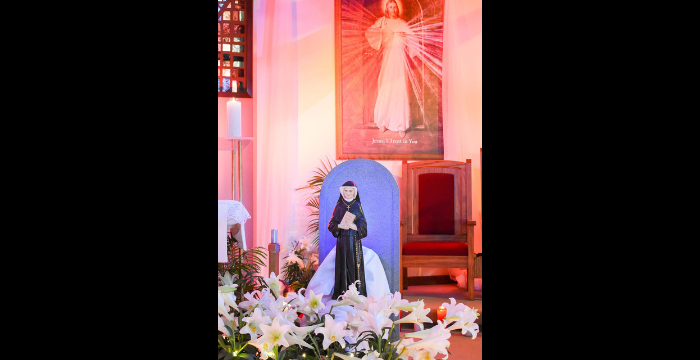
ORLANDO | Sunday, April 12, the Church celebrates Divine Mercy Sunday. The feast day ends the Octave of Easter and gives the faithful opportunities to remit the temporal punishment for their sins.
Divine Mercy Sunday Indulgences
St. Pope John Paul II established Divine Mercy Sunday “so that the faithful might receive in great abundance the gift of the consolation of the Holy Spirit. In this way, they can foster a growing love for God and for their neighbor, and after they have obtained God’s pardon, they in turn might be persuaded to show a prompt pardon to their brothers and sisters.” (Apostolic Penitentiary, Decree Indulgences attached to devotions in honor of Divine Mercy, June 29, 2002)
A plenary indulgence is “granted under the usual conditions (Sacramental Confession, Eucharistic communion and prayer for the intentions of Supreme Pontiff) to the faithful who, on the Second Sunday of Easter or Divine Mercy Sunday, in any church or chapel, in a spirit that is completely detached from the affection for a sin, even a venial sin, take part in the prayers and devotions held in honor of Divine Mercy, or who, in the presence of the Blessed Sacrament exposed or reserved in the tabernacle, recite the Our Father and the Creed, adding a devout prayer to the merciful Lord Jesus (e.g. ‘Merciful Jesus, I trust in you!’). A partial indulgence, (is) granted to the faithful who, at least with a contrite heart, pray to the merciful Lord Jesus a legitimately approved invocation.” (Apostolic Penitentiary, Decree Indulgences attached to devotions in honor of Divine Mercy, June 29, 2002)
Extraordinary Promise of Divine Mercy to St. Faustina
In her diary, St. Mary Faustina Kowalska chronicles a series of visions that occurred between 1931 and 1938. Of particular note are the repeated promises Christ made to her about the special graces associated with the feast of Divine Mercy. St. Faustina records that “whoever approaches the Fount of Life on this day will be granted complete forgiveness of sins and punishment.” (Diary, 300) On Divine Mercy Sunday, “the soul that will go to Confession and receive Holy Communion shall obtain complete forgiveness of sins and punishment.” (Diary, 699) Jesus tells her, “I want to grant a complete pardon to the souls that will go to Confession and receive Holy Communion on the Feast of my mercy.” (Diary, 1109) Simply put; by receiving the Eucharist in a state of grace on the feast, one receives the complete forgiveness of sins and the remittance of all temporal punishment for sins committed.
Divine Mercy: Divine Revelation or Private Revelation?
With the death of St. John the Apostle, public revelation ceased. The Catechism of the Catholic Church (CCC) states, “Throughout the ages, there have been so-called ‘private’ revelations, some of which have been recognized by the authority of the Church. They do not belong, however, to the deposit of faith. It is not their role to improve or complete Christ’s definitive Revelation, but to help live more fully by it in a certain period of history… Christian faith cannot accept ‘revelations’ that claim to surpass or correct the Revelation of which Christ is the fulfillment.” (CCC 67)
When instituting Divine Mercy Sunday, St. Pope John Paul II emphasized all are invited to receive the revelation of God’s merciful love through Sacred Scripture. “It is important then that we accept the whole message that comes to us from the Word of God on this Second Sunday of Easter, which from now on throughout the Church will be called ‘Divine Mercy Sunday.’” (St. Pope John Paul II, Homily for the Canonization of Sister Mary Faustina Kowalska, 4) “The Gospel is the book of God’s mercy, to be read and reread, because everything that Jesus said and did is an expression of the Father’s mercy.” (Pope Francis, Homily for the Jubilee of Divine Mercy, 1) Thus, Jesus calls us to “be merciful, just as your Father is merciful.” (Lk 6:36)
The graces associated with Divine Mercy Sunday are not extra-sacramental, but are tied to the Sacraments, efficacious signs by which we receive the grace merited once for all by Christ’s Passion. By confessing our sins and receiving absolution in Confession, we recover sanctifying grace, lost through mortal sin, and obtain forgiveness of sins. By receiving the Eucharist, we are united to Christ, cleansed from past sins, and preserved from future sins. (CCC 1393)
While no Catholic is strictly bound to give the assent of faith to the revelations recorded by St. Faustina, her saintly example of uniting herself to the merciful gaze of Jesus is a model for all to follow. This Divine Mercy Sunday, all Catholics are invited to the fount of God’s merciful love and receive the “Body, Blood, soul, and divinity of our Lord Jesus Christ, in atonement for our sins, and those of the whole world.”
By Lucas Blackwell of the Florida Catholic Staff, April 10, 2026