Catholic Charities shares disaster response expertise
ORLANDO | More than 200 attendees representing nearly 70 Catholic Charities agencies gathered in Orlando March 16-20, 2026, for the Catholic Charities USA (CCUSA) Applied Institute for Disaster Excellence training hosted by Catholic Charities of Central Florida (CCCF).
“The Applied Institute for Disaster Excellence training held in Orlando was defined by the same spirit of collaboration that animates all of the disaster preparedness and relief work of the Catholic Charities network,” said Kerry Alys Robinson, president of CCUSA. “Staff and volunteers from across the country came together to learn from one another and to prepare to spring into action at a moment’s notice to help their sisters and brothers in need in the wake of a disaster. It was inspiring and invigorating to be in the company of so many colleagues dedicated to serving those most in need in the name of the Catholic Church.”
Catholic Charities is the third largest disaster response network in the United States.
“Catholic Charities of Central Florida was an ideal host because of their demonstrated excellence in providing disaster relief and their proven track record of contributing to successful collaborative efforts with their fellow Catholic Charities agencies across the state of Florida,” said Kim Burgo, vice president for Disaster Operations for CCUSA. “We are so grateful to Deacon Gary Tester and his outstanding team for their sharing their expertise and their warm hospitality with the broader Catholic Charities network.”
Deacon Gary Tester, president of CCCF, shared the training is designed to bring the network’s members together to discuss “the best practices we’re using, what are the partnerships we’re driving, and how do we continue to build on those.” CCCF sent eight staff members to the training, two of whom achieved a certification in disaster case management.
Deacon Tester presented a workshop on the Diocese of Orlando Emergency Operations Center, which is the only one of its kind in the entire 200-plus member CCUSA network. It began after the diocese’s response to the Pulse nightclub shooting in 2016. Since the diocese provides a wide range of ministries and resources, “we began to look at what we could do to more appropriately come together to respond” in the event of a natural or human-caused disaster. The goal was to mobilize a disaster response from the diocese with a single phone call.
Following Hurricane Irma in 2017, “the agency partnered with local parishes to provide emergency food and water distribution services in hardest hit areas. And so, from there it just began to evolve, and we are now the only diocese in the United States that has an emergency operation center associated with the diocese, facilitated by a (Catholic) Charities agency,” he said.
Deacon Tester also moderated a panel regarding mutual aid agreements and joint disaster responses, featuring Catholic Charities of Florida. “The seven Catholic Charities agencies in the state are recognized nationally for the network that we have in terms of disaster response. We seven agencies share a mutual aid agreement that pulls us together in times of disaster. We work very well together, and it’s a model that Catholic Charities USA is trying to emulate for other states where they have multiple Catholic Charities agencies in place.”
These agreements promote “interaction between agencies following a disaster so that if Orlando is not hard hit, but St. Petersburg is, we can ship supplies from our diocese over to their diocese, (and) we can actually send personnel to help their teams recover.” The reciprocity fostered by these agreements “allows us to know that in a time of disaster, we can count on help from others in our immediate state, and also that others in the state can count on us stepping out to help them as is necessary,” Deacon Tester said.
The Society of St. Vincent de Paul Diocesan Council of Orlando is one such organization that has a mutual aid agreement with CCCF. The society, through its two dozen conferences across nine counties in central Florida, offers a variety of resources from providing food and rental assistance for low-income families and scholarships for high school students to operating thrift stores and a prison ministry.
Trace Trylko, executive director of St. Vincent de Paul Orlando, led a workshop with Deacon Wilmar Rojas, director of operations at CCCF, about the disaster response partnership.
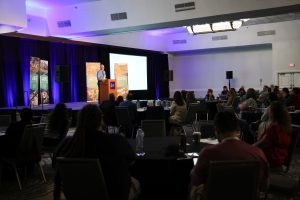
YVETTE PRATDESABA | FC
“We work together before, during, and after disasters such as a hurricane, (or other) weather related situations,” Trylko said. “The more times we can work together, the better.”
The workshop encouraged attendees in “their work with disaster relief through Catholic Charities across the country to partner with not just St. Vincent de Paul, but with other organizations as a force multiplier.” Trylko also stressed the importance of collaboration and teamwork during a disaster response. “We need all of these organizations working together because the need is great, especially in the wake of a disaster.”
Catherine Galda, director of behavioral health services for CCCF, presented two workshops at the training. In her role, she oversees the mental health counseling services and mental health literacy program that the agency provides, in addition to her work with the CCCF response teams.
Galda’s first workshop — “Compassion and Action” — focused on the CCCF’s trauma informed response team.
“When tragedy strikes, people go back to their faith, and that gives us an opportunity to be able to come alongside people in times of suffering.” She spoke about the origins of her team at CCCF, explained how participants can form their own team in their diocese, and walked through a few scenarios, based on her experience, on how to handle mental health challenges.
The teams are to be “the boots on the ground to help (during a disaster) and support in the moment and then be a resource that a person can call in the aftermath,” Galda said. The teams consists of nearly 40 CCCF staff members trained in mental health and psychological first aid. “When the community needs us, we can deploy, and we step in and we provide… the connection, the support, the resources, and the information.”
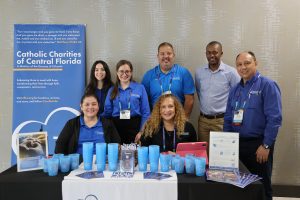
YVETTE PRATDESABA | FC
Her second workshop dealt with the expansion and contraction of behavioral health services during a disaster response operation. “We have a large pool of clinicians with different areas of expertise and different locations, and different places and genders, so we can really match, as very best we can, the ideal clinician for the client and their issues and their preferences.” Due to the importance of the therapist-client relationship, finding the best possible fit is essential for positive outcomes.
Galda emphasized there is a real need for her clinical team to be present during disaster response efforts. “In the aftermath of disaster… our internal resources are depleted.” In addition to ensuring one’s basic needs are met, “there’s also an emotional, cognitive, and mental health related component that goes into this, and when we are under high levels of stress for long periods of time, (we) can have mental health as well as physical health breakdown.”
Galda explained disaster victims often feel anxious and fearful, which is “normal and natural. But what can happen is that (these emotions) build up and they don’t dissipate… when they don’t dissipate, they can turn into a true mental health challenge or a mental health disorder.” The disaster response team tries to help victims effectively normalize their experience by giving them resources and tools to help them support loved ones, and effectively thwart a mental health challenge from becoming a mental health disorder. Depression, anxiety, and post-traumatic stress disorders are the most common mental health disorders they see.
For Juan Vega, director of food ministries for CCCF, attending the training was a worthwhile experience. “The networking was incredibly valuable—being in the room with emergency management professionals and partner organizations reinforced just how critical collaboration is in disaster response.” He shared the training “highlighted the power of relationships — we truly cannot do this work alone, and coordinated partnerships are essential before, during, and after a disaster.”
For Vega, “representing our organization at a national training of this caliber was an amazing experience and a proud moment.” He is grateful to play a small role in CCCF’s disaster response work. “The ability of faith-based organizations to respond, deploy quickly, and serve the community with compassion and efficiency is remarkable. Being part of that collective effort (is) both humbling and inspiring.”
Bishop John Noonan said he is proud of the role Catholic Charities plays in saving lives.
“Catholic Charities cares about what happens after a disaster and trains to deal with the aftermath of destruction, all based on love of God and love of neighbor. That calls for more than courage, it calls for love and dedication. After any major catastrophe there is a deep sense of loss and a feeling of total abandonment. When an organization like Catholic Charities arrives on scene offering help, it can be lifesaver and sign of hope to be able to continue to look to the future.”
By Lucas Blackwell of the Florida Catholic Staff, April 10, 2026