ORLANDO | With hurricane season underway and summer storms constantly brewing, Catholic Charities of Central Florida provides disaster case management training for partners in and beyond the Diocese of Orlando.
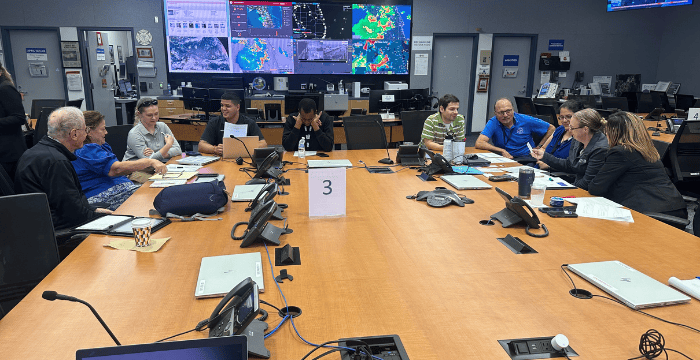
Between June 30 and July 1, 2026, attendees learned about resources available in case of a disaster, how to discern priorities, set up distribution sites, and assist neighbors in need.
“The goal is to help Catholic Charities agencies and their community partners build the capacity for disaster case management,” said Melissa Hruska, Catholic Charities USA trainer. “So, if they are impacted by any type of disaster, they at least have the background information and foundational tools to get started. We know that the better we do in response, the better recovery looks ultimately in the end.”
Deacon Wilmar Rojas, Catholic Charities of Central Florida senior director of operations, said the two-day certification enables Catholic Charities and other organizations like St. Vincent de Paul to provide emergency management case managers to FEMA and other agencies. Those trained can assist in local disaster recovery or aid other locations as a community partner. When working with other counties, everyone uses the same language and can streamline operations.
Edward Martinez is part of Volusia County’s emergency management. He works with nonprofits and in managing crises post-storm — cost recovery, housing, job loss and more. His experience in Puerto Rico after Hurricanes Irma and Maria plus his 13 years of military experience and two years with FEMA, gives him a distinct perspective. He attended the training to learn specifically about disaster case management and connect with partners capable of providing what his team may lack. He also hopes to bring what he learned back to Volusia.
Martinez said it is helpful to work with Catholic Charities and organizations that will step in and handle donations.
“A lot of times after our disasters, people want to come in and donate. As government agencies, we can’t accept money or stuff, but we partner with a lot of nonprofits and profit agencies. They do that for us, and we do a lot of coordination,” Martinez said.
His partner, Madeline Powell, handles general population and special needs shelters for anyone with long-term medical considerations.
“With transitional sheltering, we might have to employ some disaster case managers or case workers. So, I just wanted to get a better understanding of what that process looks like,” she said. “I think getting a better understanding of that and the techniques employed by disaster case managers, in just talking with survivors of a disaster, was also great to know.”
When asked how senior residents could benefit from what she learned, she suggested, “first and foremost, registering for the state special needs registry is a great step so that even if they don’t need disaster assistance in the moment, we at least have them on our radar.
“We can do call-downs to check on them, make sure that they’re okay, and then first responders have that information as well, so if we have to do wellness checks, things like that, they already have their address; they know what their considerations are. And then, of course, knowing this information helps me to have a better understanding of what organizations we can work with for disaster case management.”
Deacon Rojas said this teamwork makes a difference. “To know that the diocese, through Catholic Charities, is connected to all the resources that will be available before, during, and after any disaster eases stress.” He added, “It’s reassuring that we’re all not just looking out for their spiritual well-being, but also for the physical and other needs.” Catholic Charities often coordinates distribution of sandbags prior to an event and water, food, tarps and more after. Then case managers work on the long-term effects – helping people who lost jobs and homes. This recovery may continue six months to a year after a storm. “We’re there to work with them, walk with them, and get them to some sort of recovery,” he said.
Bill Marcous is a Vincentian out of Annunciation Parish in Altamonte Springs. He helps coordinate disaster management for St. Vincent de Paul and wanted to learn more specifics. As a former utility manager in San Francisco, he is familiar with FEMA, but he is not a case manager.
“I’m learning a lot more about that aspect of how case management can interface with these agencies to give people help,” he said. He takes back to St. Vincent de Paul an increased knowledge on how to better assist individuals, what is required in terms of documentation, and a deeper appreciation for the “patience and persistence and willingness to go through a long process in order to achieve a very important goal.” Marcous said, although St. Vincent de Paul offers case management on a regular basis, it is for a shorter term-covering someone’s rent or utility bill for instance.
Bernard Morris also came representing St. Vincent de Paul, for St. Ann Parish in Haines City. He hopes the training allows him “to be a resource for the organization in an area where (they) don’t typically spend a lot of time.” He will share the resources he learned going forward, “on the basis of a need that we hope never comes.” He said the training will help complement the daily services they provide, in case of “a larger disruption.”
The training took place at the City of Orlando EOC. Manuel Soto, EOC emergency manager for the City of Orlando, said, “I think it’s critical for us to support our nonprofit and faith-based organizations within our community that have a common humanitarian assistance mission. Because the reality is that, if we get hit by a hurricane or any disaster, we’re all going to be in the same boat…. From a government perspective, I provide services to a certain point, but that continuum of care is done by Catholic Charities, Red Cross, Salvation Army. And the people that you’re serving are our citizens.”
Visit Catholic Charities of Central Florida to learn more.
By Glenda Meekins of the Florida Catholic staff, July 10, 2026