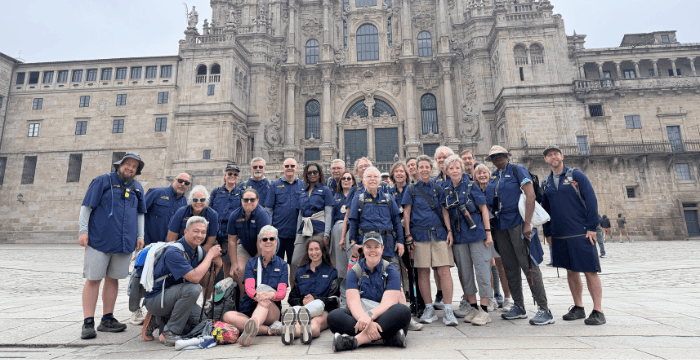
LONGWOOD | Seeking a physical challenge and spiritual nourishment, a group of 26 individuals, ages 23 to 79, embarked on El Camino de Santiago this summer.
Father David Scotchie, pastor of Nativity Parish in Longwood, began an annual pilgrimage program last year. Led by Billy Williamson, director of liturgy and music, their first excursion was to Italy, where a small group sang at the Vatican. In 2024, Williamson and his wife completed the Camino Francés from León to Santiago de Compostela in Spain and shared their experience at a parish luncheon. Their presentation received an enthusiastic response, and El Camino de Santiago was chosen for 2026.
“El Camino de Santiago translates to ‘The Way of St. James,’” Williamson said. “The two most popular routes today are the French route, which starts in the Pyrenees mountains of France, and the Portuguese route, which starts in either Lisbon or Porto.” The pilgrimage ends in the Spanish city of Santiago de Compostela, “where the Cathedral of St. James is and where the apostle’s final resting place on earth is.”
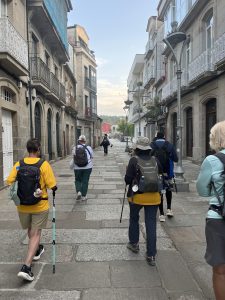
“To earn your compostela, which is the certificate of completion from the pilgrimage office, you have to walk a minimum of 100 kilometers (just over 62 miles),” Williamson said. The group began their pilgrimage in Vigo, Spain, and walked 101 kilometers in seven days. “At the end of the day, the people on this pilgrimage (are) what made it a special experience.”
The group met twice a month for the last 10 months preparing for the pilgrimage. “Once to walk and once for something else. We did a Spanish class, one day we talked about the history of the Camino,” Williamson said. “We did all sorts of different things.”
Patricio Chandia, Nativity parishioner and pilgrim, said the group tried the best they could.
“We had time to meet with everybody going, build relationship (and) friendship.” This preparation not only allowed each participant to be physically ready for the experience but created familiarity and camaraderie within the group.
For Chandia, the decision to join the pilgrimage was profoundly personal. “It was more of a personal promise that I had made, and I wanted to complete it,” he shared. “My dad passed away 10 years ago. My mom passed away like five years ago. So, I made them a promise that I was going to do it in their honor.” Chandia realized, “I wanted to challenge myself (and) get out of my comfort zone… just do something that you don’t do every day.”
“What stood out the most to me is… meeting people from different parts of the world,” he said. He recalls every pilgrim they encountered “were all in the same path, in the same goal to make it to Santiago.” “We all went through
struggles… and just making it I think that was the best part.”
Sandy McCann received the Sacrament of Confirmation just seven days before leaving for Spain. She saw the pilgrimage as an opportunity to deepen her faith. As a breast cancer survivor who deals with lingering health problems, she said, “I just wanted to see if I could do it.”
“We just would say the rosary as we were walking, and we would do our (Liturgy) of the Hours at evening time, sometimes in the morning, especially if we didn’t have a Mass to go to,” explains McCann.
“It was physically and mentally challenging, but spiritually, it was wonderful.”
The excitement from the pilgrimage has participants eager to continue the journey. Members from the group recently learned about the Baby Steps Camino, a three-day pilgrimage from Jacksonville Beach to St. Augustine in December. “There’s been so many of us (who) want to do it,” says McCann. “We’re ready to go again in the Lord’s name.”
While walking such a long distance in a short time may seem intimidating, Williamson said the journey is doable for pilgrims of all ages. “Every time you pass a little church in (a) small town, you’re stopping at that church. Every time you pass a cafe, you stop, you get a piece of cake, you get a snack, you get a drink, you take a rest… it’s something that you do gradually. It’s not a race, which makes it so much more accessible.” Their longest walking day was 14 miles,
the shortest six miles.
The pilgrims learned to walk in the presence of God. Williamson recalls it is comforting to know we have a gracious God who can “help us and (will) walk us through anything, whether it be the day-to-day trials of life or walking up and down Spanish hills.”
By Lucas Blackwell, July 22, 2026