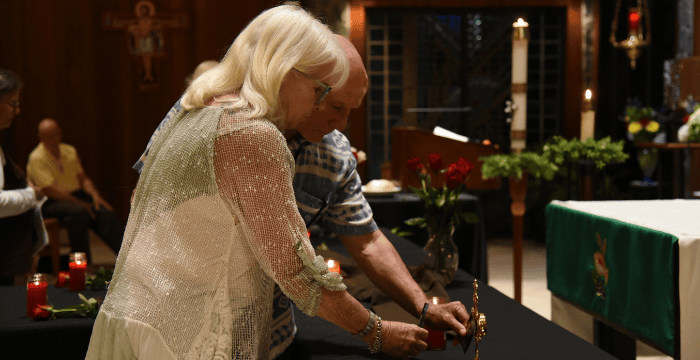
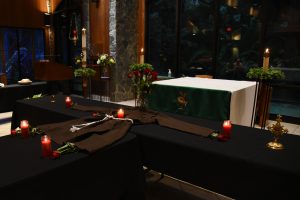
WINTER PARK | The light in Mary, Mother of God Chapel is dimmed accentuating the flickering candles set upon a brown Franciscan robe, with candles and roses marking where St. Francis of Assisi’s stigmata bore witness to his beloved Christ Jesus.
It is Oct. 3, 2026, and those gathered are commemorating Transitus, the somber recollection of St. Francis’s passing from his earthly life to eternity. Created by Franciscans to honor the journey of their patron, St. Francis, from life to Sister Death, the tradition continues 800 years after his passing. The chapel at San Pedro Spiritual Development Center filled with lay Franciscans, Franciscan clergy and other admirers of the man who some say came the closest to the likeness of Jesus in his lifetime.
Kathy Ramsey, secular Franciscan and minister of the Lady Poverty Fraternity at San Pedro, described the experience as “very emotional” for her and many of her fellow Franciscans. “I think (Transitus) helps us. It helps me reconnect with St. Francis and why I’m still called. I’m still chosen to be a Franciscan, to know that St. Francis followed Christ so closely that he became one with Christ.” She acknowledged this is the call of every Christian.
She recalled the writings of Brother Thomas of Celano who described the last days of his beloved founder, including his desire to go back to the state in which he was born, with nothing but the mark of God’s creation, his own naked body. She thought of his great suffering in the last two years of his life, during which he suffered from leprosy and the stigmata and wrote perhaps his most famous poem, Canticle of the Creatures (also known as Canticle of Brother Sun) where he praises all of God’s creation.
“He expressed everything with great joy and love, even during this time where most people might be despairing or desperate. And I think that he shows us how to live and he shows us how to die. He shows us how to make ourselves ready and prepared to step from this world into the next,” she said.
Living in an age when euthanasia is on the rise to escape suffering, she affirms much can be learned from studying the life and death of St. Francis.
For Faith Libbe, who recently celebrated 25 years as a secular Franciscan, the evening was especially powerful as she now spends six months of the year living in Georgia. The return to the chapel where she made her profession after leading a group of 29 pilgrims to Assisi to visit St. Francis’s home and tomb was particularly special. She thought of how so much began with the San Damiano crucifix where St. Francis heard the Lord calling him.
She, like Ramsey, felt a renewal of her commitment, to “have an open heart” to listen to what the Lord is calling her to do.
Pondering the experience a day later, she said her thoughts were more about life than death. “What Transitus has meant to me over the years is a beautiful opportunity to gather with my local fraternity on this special night to recall Francis’ passing into eternal life. But it is a night also of oneness with our entire worldwide Franciscan family (and those Franciscan in their hearts),” she wrote in an email to Florida Catholic.
Citing Jn 12:24, “Amen, amen, I say to you, unless a grain of wheat falls to the ground and dies, it remains just a grain of wheat, but if it dies it produces much fruit,” she noted in the 800 years since his passing, St. Francis “indeed produced much fruit.” Today there are roughly 650,000 Franciscans active in 110 countries worldwide.
Father Anthony Aarons led a Franciscan retreat at San Pedro coinciding with the 800th anniversary of St. Francis’ death and feast day. He too felt the pull to ask, “What is my call to holiness?” as he spoke of the ministry of St. Francis.
“When you think about it, it’s a call to inclusion, because his first and primary ministry was to the lepers,” shared Father Aarons. “And the lepers were the outcasts. And as I said to the people on the retreat, who are the lepers in our world today that God is sending us to bring them in? The ones that we embrace and kiss. Because once we embrace the cross, we must embrace all humanity.”
He added, “It actually teaches us to embrace Sister Death so that we are not to be afraid of death, but that we should be prepared to die… And really, if what happened with him being so transformed into the likeness of Christ is the same thing that happens to us in our death, then the Franciscans, like all Christians – we embrace the cross because by the Holy Cross Christ has redeemed the world and therefore, we are prepared for that redemption.”
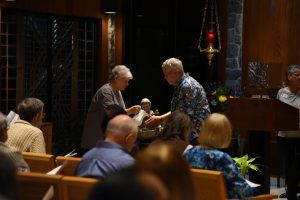
Transitus provides an opportunity to ponder what this redemption means for each Christian. It encompasses a summary of the way St. Francis lived, in communion with his brothers and sisters, in communion with the Lord through the Eucharist, the earth and in communion with eternity as an ongoing reality.
The program recalls his joy in entering the eternal life by asking his brothers to “come and praise Sister Death for me,” (LP100). Arriving with tears in their eyes they proclaimed the Canticle of Brother Sun that Francis “had composed during his sickness for the glory to God and for the consolation of his souls and that of the others,” (LP100).
Asking for bread, Francis blessed it and gave it to each of those gathered. After requesting the gospel of John 13 be read, all came forward to have their hands washed, recalling the Last Supper.
Then, joining in where he could, St. Francis prayed Psalm 142, his favorite. At this moment during Transitus, the words of St. Francis were spoken – a message for all that continues to resound throughout the ages – “I have done what was mine to do. May Christ teach you what is yours.”